
Orthopaedic Physiotherapy at Home
A BPT/MPT physiotherapist treats joint, bone and muscle problems in your own home across Delhi NCR — knee, back, neck and shoulder pain, arthritis and fracture recovery. 45–60 minute sessions, ₹900–₹2,000 per visit.
Other Services

Quick answer: Orthopaedic physiotherapy at home treats bone, joint and muscle problems in your own home: knee, back, neck and shoulder pain, arthritis, fractures and stiffness after injury. The physiotherapist assesses you, relieves pain and builds strength and movement with guided exercise.
- Bring to the first visit: any X-ray or MRI reports.
- Cost: ₹900–₹2,000 per visit. Pay per visit, no packages.
- Session: 45–60 minutes, Monday to Saturday, 9am–6pm.
- Who visits: BPT/MPT qualified therapists, led by founder Dr Shivani, 14 years in physiotherapy.
- Areas: Delhi, Gurugram, Noida, Ghaziabad and Faridabad.
Updated November 2026
What Orthopaedic Physiotherapy at Home Treats
Orthopaedic physiotherapy at home is treatment for the musculoskeletal system — joints, bones, muscles, ligaments and tendons — delivered by a physiotherapist who comes to your house. The aim is less pain, more movement and the strength to get back to normal life, without the journey to a clinic. We visit homes across Delhi, Gurugram, Noida, Ghaziabad and Faridabad; a visit costs ₹900 to ₹2,000 and normally lasts 45–60 minutes, depending on the condition.
This page is for adults whose problem is in a joint or the spine: a knee that hurts on the stairs, a stiff frozen shoulder, a back that locks after long hours at a desk, an ankle that never quite recovered from a sprain, or a wrist just out of plaster.
At a glance
- Who treats you: a BPT or MPT physiotherapist with orthopaedic experience
- Session: 45–60 minutes, assessment plus treatment at the first visit
- Fee: ₹900–₹2,000 per visit, no package
- Equipment brought: TENS, IFT, ultrasound and muscle stimulator
- Timing: Monday to Saturday, 9:00 am to 6:00 pm (closed Sunday)
Orthopaedic conditions we treat at home
| Body area | Common conditions |
|---|---|
| Knee | Knee osteoarthritis, knee pain on stairs, ligament (ACL, MCL) and meniscus injuries, runner’s knee, stiffness after a fracture |
| Spine | Lower back pain, sciatica, slipped or bulging disc, cervical and lumbar spondylosis, posture-related neck pain |
| Shoulder | Frozen shoulder, rotator cuff strain, shoulder impingement, stiffness after a dislocation |
| Hip | Hip arthritis, bursitis, weakness and stiffness before or after hip surgery |
| Elbow, wrist and hand | Tennis and golfer’s elbow, wrist stiffness after a cast, carpal tunnel symptoms |
| Foot and ankle | Ankle sprains, plantar fasciitis and heel pain, Achilles tendon pain |
Treatments an orthopaedic physiotherapist uses at home
- Manual therapy and joint mobilisation to free stiff joints and ease pain
- Soft-tissue release and stretching for tight muscles and tendons
- Progressive strengthening using body weight, resistance bands and household objects
- Electrotherapy — TENS and IFT for pain, therapeutic ultrasound for soft-tissue healing, muscle stimulation for weak muscles
- Posture and movement correction for desk work, lifting and stairs
- A written home exercise programme so progress continues between visits

What Happens at the First Visit
- History, pain pattern and a review of X-ray or MRI reports
- Movement, strength and joint tests to find the cause, not just the sore spot
- Hands-on treatment and electrotherapy in the same session
- Measurable goals and a written home exercise programme
Is orthopaedic physiotherapy at home as good as a clinic?
For most joint and spine problems, yes. The assessment, manual therapy, exercise and portable electrotherapy are the same, and practising on your own stairs, chair and bed often carries over to daily life better. A clinic mainly helps when you need heavy gym machines or traction tables. Clinical guidelines such as those from the National Institute for Health and Care Excellence (NICE) recommend exercise as a core treatment for osteoarthritis — something that is easy to do consistently at home.
How many sessions will you need?
It depends on the problem. A recent sprain or acute neck pain may settle in a few visits. Knee osteoarthritis, frozen shoulder or a disc problem such as sciatica usually needs regular sessions over several weeks, with exercises in between. Your physiotherapist sets goals at the first visit so you can see whether it is working.
When to see a doctor first
Physiotherapy is safe for most joint pain, but see a doctor before starting if you have pain after a fall or accident that may be a fracture, numbness or weakness spreading down an arm or leg, loss of bladder or bowel control, unexplained weight loss or fever with back pain, or a hot, swollen joint.
Related services
After joint replacement or fracture surgery, see post-surgery physiotherapy at home and knee replacement recovery. For long-standing pain, see pain management physiotherapy at home; for injuries from sport or the gym, sports injury physiotherapy.
Home visits run across Delhi, Gurugram, Noida, Ghaziabad and Faridabad. Gurugram patients can also see our physiotherapist home visit service in Gurugram, and Delhi patients our physiotherapy at home charges and areas page.
Ready When You Are
Tell us where it hurts, how long it has been going on, and your locality. Attach any X-ray or MRI reports. We match a physiotherapist and send their details and the fee before the first visit.
Charges: ₹900 to ₹2,000 per home visit, depending on your condition and what the session involves. No packages — you pay per visit. Any travel charge for your sector is confirmed on WhatsApp before you book, so there are no surprises on the day. Visits Monday to Saturday, 9:00 am to 6:00 pm (closed Sunday).
Frequently Asked Questions
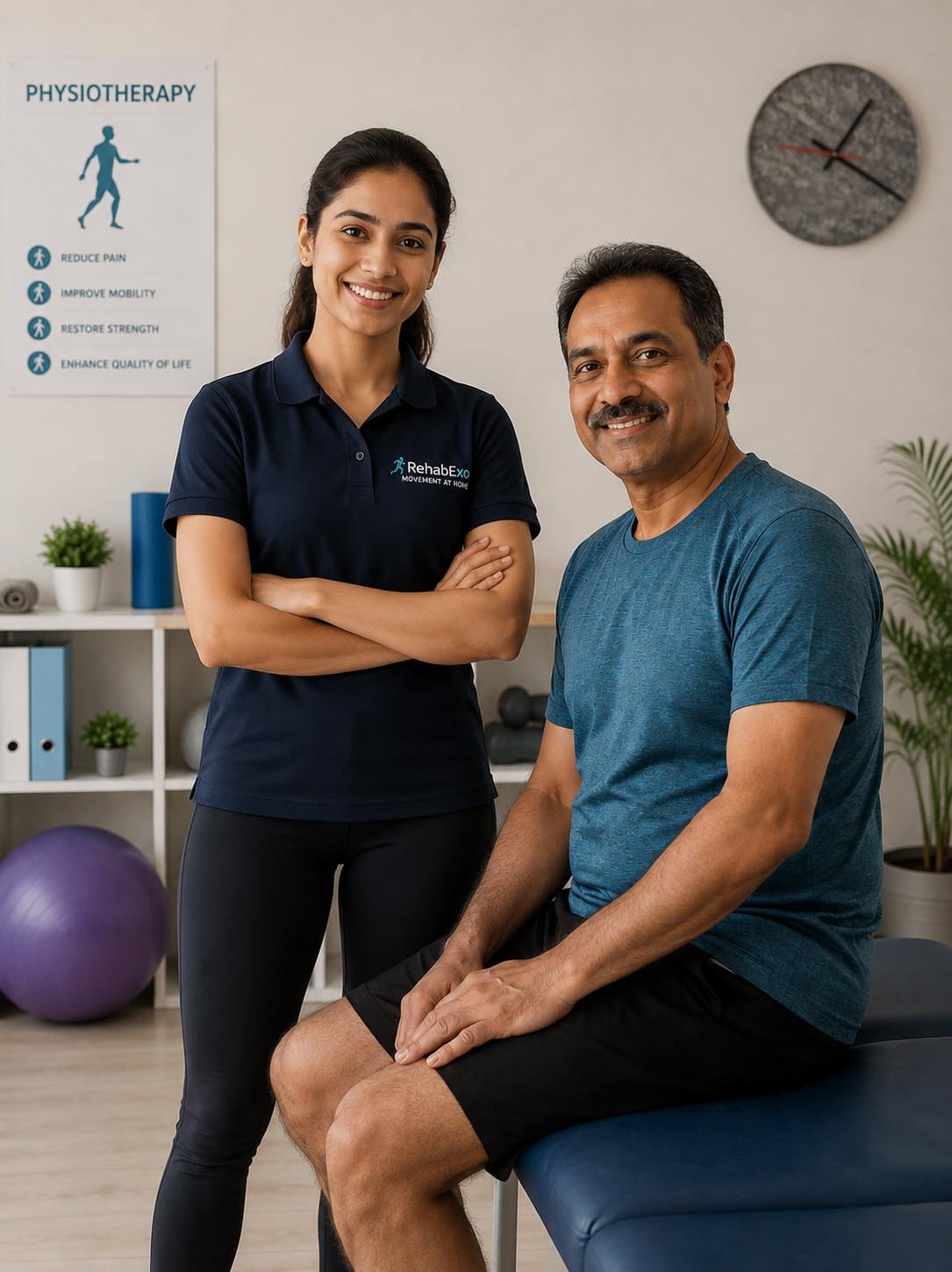
Orthopaedic physiotherapy treats problems of the joints, bones, muscles, ligaments and tendons — such as knee pain, back pain, frozen shoulder, arthritis and recovery after fractures — using exercise, manual therapy and electrotherapy.
Yes. A BPT or MPT physiotherapist visits your home across Delhi, Gurugram, Noida, Ghaziabad and Faridabad, brings portable TENS, IFT and ultrasound equipment, and treats you in a 45–60 minute session.
₹900 to ₹2,000 per visit, depending on the condition and what the session involves. You pay per visit with no package.
Yes. Strengthening and range-of-motion exercise is a first-line treatment for knee osteoarthritis. It reduces pain and improves walking and stairs, and continuing the exercises at home is what keeps the benefit.
Most disc problems improve without surgery. Physiotherapy reduces pain and nerve irritation, restores movement and builds core strength to prevent recurrence. See a doctor first if you have leg weakness or bladder changes.
Frozen shoulder is slow — often many months. Regular physiotherapy and daily home stretches help keep movement and reduce pain while it recovers.
No referral is needed to book. If you have reports or a doctor’s note, share them so the physiotherapist can plan around them.
Usually not on its own. Most Indian health policies exclude home physiotherapy, though some cover it as a post-hospitalisation expense after an approved inpatient claim, or under an OPD add-on. Check your policy wording before you start.
We visit homes across Delhi, Gurugram, Noida, Ghaziabad and Faridabad. Message your locality on WhatsApp and we confirm availability and any travel charge before you book.
No. Visits run Monday to Saturday, 9:00 am to 6:00 pm (closed Sunday).
Testimonials
What Families Say
Real recovery stories from patients and families across Delhi NCR.
Our Home Therapy Services
Who Visits You
RehabExo is founded and clinically led by Dr Shivani (PT), a sports physiotherapist with DCPT credentials and 14 years of experience in physiotherapy and more than 1,000 patients treated. Our 8–10 physiotherapists are BPT or MPT qualified, credential-verified before their first visit, and average three years or more of clinical experience. We match you to a physiotherapist with orthopaedic experience and send their details before the first visit.